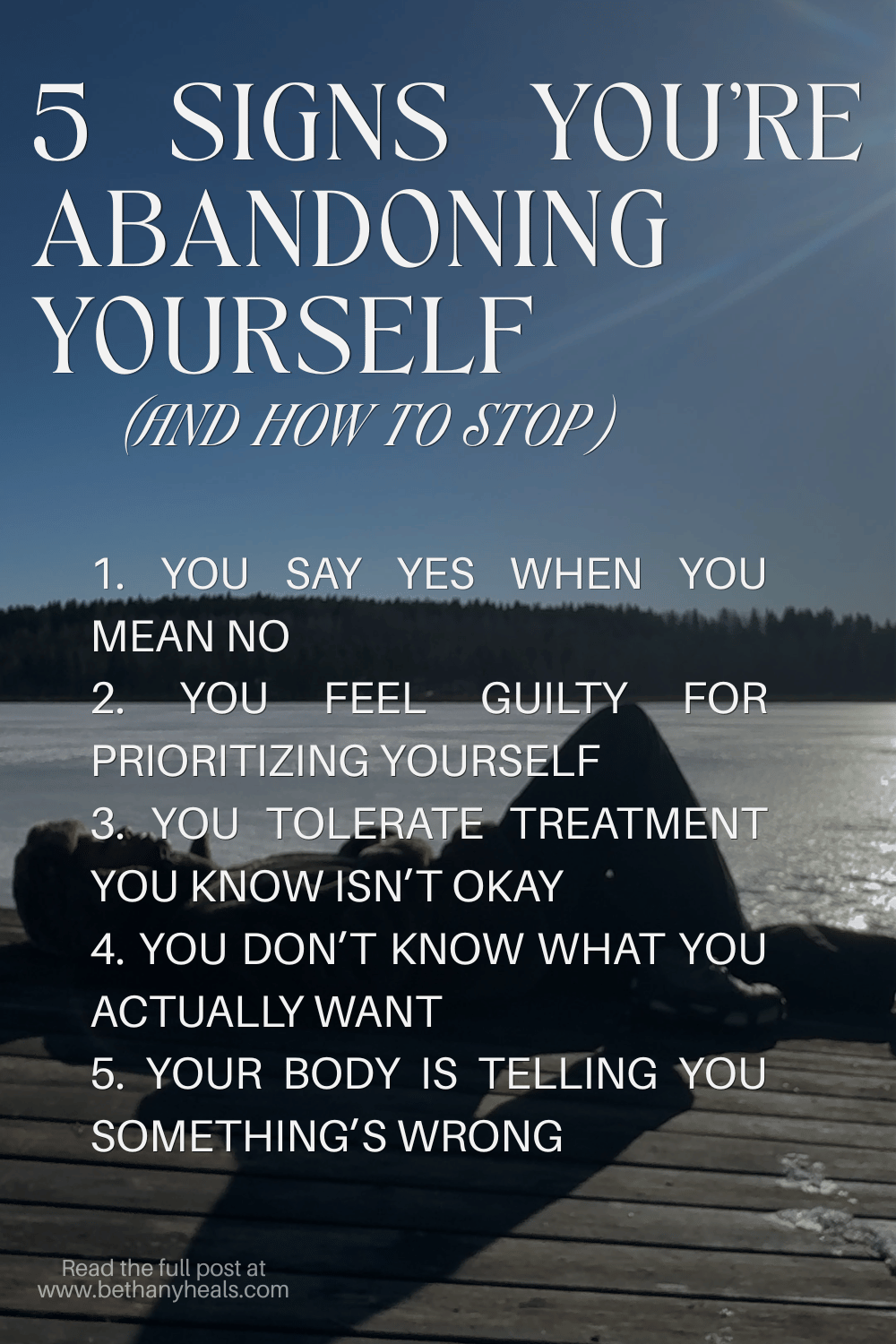
Signs You’re Abandoning Yourself (And How To Stop)

You know the feeling.
You say yes when you mean no. You stay quiet when something doesn't sit right. You adjust yourself to keep the peace. You make sure everyone else is okay… and tell yourself that’s what being a good person looks like.
And then one day, you wake up exhausted. Hollow. Wondering why you feel so disconnected from your own life. Like you’re living your life, but you’re not really in it.
That's self-abandonment.
It's not done consciously or on purpose. It's not a single moment. It's the small, repeated choices you make every day that slowly pull you further and further away from yourself. The thing is, most people don't even realize they're doing it. Self-abandonment doesn't announce itself. It disguises itself as kindness, as being a good friend, as keeping the peace, as being responsible.
But underneath all of that? You're disappearing.
➝ It’s not something that happens to you.
➝ It’s something you participate in.
And the more you do that, the harder it becomes to hear yourself at all. If you've been feeling stuck, drained, or like something is off but you can't name why, start here. These are the five signs you're abandoning yourself. And more importantly, what to do about it.
“5 Signs You’re Abandoning Yourself”
Sign #1: You Say Yes When You Mean No
You already knew you didn’t want to do it. And you said yes anyway.
This is the most common form of self-abandonment. And it's so normalized that most people don't even recognize it as a problem.
Someone asks you for a favor. You didn’t have the energy or the time.You said yes anyway. And now you’re annoyed at them for a decision you made.
Why?
Because it felt easier than saying no. Because saying no feels selfish. Because you don't want to disappoint them. Because you're worried about what they'll think of you if you set a boundary. So you override what you actually feel and say yes. And then you resent them for asking. Even though they didn't do anything wrong. But the resentment isn’t actually about them.
What's actually happening:
Every time you say yes when you mean no, you’re training yourself to disconnect from your own boundaries. Because you don’t trust yourself to hold them. You're teaching yourself that your needs can wait. And over time, that becomes your default. You stop even asking yourself what you want.
Because you already know you’re not going to choose it.
What to do instead:
Slow it down.
Start small. The next time someone asks you for something and your immediate internal response is resistance, pause. Don't rush to respond. Just say: "Let me think about it and get back to you."
That buys you time. Time to check in with yourself. Time to ask: Do I actually want to do this? Or am I just saying yes out of guilt? And then practice saying no without justifying it. You don't owe anyone an explanation for protecting your energy.
"I can't" is a complete sentence.
Sign #2: You Feel Guilty for Prioritizing Yourself
You finally carve out time for yourself.
Time to rest. Time to do something you enjoy. Time to just be. And instead of feeling good about it, you feel “off”. You think: I should be doing something productive. I should be helping someone. I should be working. I should be available.
So you cut your rest short. You check your phone. You respond to messages. You make yourself available even though you said you were taking time for yourself. You don’t even let yourself finish resting.
What's actually happening:
You've internalized the belief that your worth is tied to your productivity and your availability to others.So when you stop doing those things…
➝ your system reads it as: rest feels selfish. Doing nothing feels lazy. Prioritizing yourself feels wrong. But you can't pour from an empty cup. And if you never give yourself permission to refill, you'll eventually burn out. The guilt you feel isn't proof that you're doing something wrong. It's proof that you've been conditioned to believe that your needs don't matter.
What to do instead:
Let the discomfort be there. Give yourself permission to rest without earning it. You don't need to be productive all day to deserve rest. You don't need to hit a certain threshold of exhaustion to justify taking care of yourself.
Rest is not a reward. It's a requirement.
Not everything that feels wrong is wrong. Sometimes it’s just new. Instead of escaping the guilt, sit in it. Start protecting your rest the same way you protect your commitments to other people. Block it off in your calendar. Turn off notifications. Let yourself actually be unavailable. And when the guilt comes up (because it will), remind yourself: Prioritizing myself isn't selfish. It's the foundation. Then stay.
Sign #3: You Tolerate Treatment You Know Isn't Okay
You know the dynamic is draining you.
You know the relationship is one-sided. You know the way they speak to you isn't okay. The way you feel after interacting with them.
The way you have to adjust yourself to make it work. But you stay quiet. You make excuses for them. You tell yourself it's not that bad. You convince yourself that if you just adjust a little more, if you just give a little more, things will get better.
They don't.
What's actually happening:
You're choosing to protect someone else's comfort over your own well-being. Because:
you don’t want to disrupt it
you don’t want to lose it
you don’t want to deal with what happens next
And the longer you stay in dynamics where you have to disappear to make room for someone else, you reinforce the belief that this is what you deserve.
What to do instead:
Start with honesty. Out loud. To yourself first.
“This isn’t working for me.”
You don't have to confront them yet. You don't have to leave yet. You just have to stop lying to yourself about what's happening. Because once you stop pretending it’s fine… you can't un-see it. And that's the first step toward change.
Then ask yourself: Why am I tolerating this?
Is it because you don't think you deserve better? Is it because you're afraid of being alone? Is it because you don't trust yourself to set a boundary and stick to it? Get honest about the real reason. Because you can't shift a pattern you won't acknowledge.
And then decide: What's no longer negotiable?
Not what you think you should tolerate. What you're actually willing to tolerate. And hold that line.
Sign #4: You Don't Know What You Want
What do you want?
Someone asks you what you want for dinner. You say "I don't care, whatever you want."
Someone asks you what you want to do this weekend. You say "I'm good with anything."
Someone asks you what you need. You say "I'm good."
And you mean it. Because you genuinely don't know what you want anymore.
What's actually happening:
You've spent so long overriding your own desires to accommodate everyone else that you've lost touch with what you actually want. Your wants feel unclear. Your needs feel inconvenient. Your preferences feel irrelevant. And when you do feel a pull toward something, you second-guess it. You talk yourself out of it. You convince yourself it's not practical, it's not realistic, it's not worth pursuing. And you disconnect from them altogether.
What to do instead:
Start asking yourself what you want. Every day. In small, low-stakes moments.
➝What do you want for breakfast?
➝ What do you want to wear?
➝ What do you want to do with the next hour?
And then choose it. Even if it feels silly. Even if it doesn't matter. Even if no one else cares. Because the more you practice tuning into what you want in small moments, the easier it becomes to hear yourself in bigger ones. This is how you rebuild trust with yourself. And if you genuinely don't know? That's okay. Start with what you don't want.
Sometimes clarity comes from elimination.
Sign #5: Your Body Is Telling You Something's Wrong
The back pain. The jaw clenching. The tightness in your chest every time someone texts you. The exhaustion that doesn't go away no matter how much you sleep.
You tell yourself it's stress. It's just a busy season. It'll pass.
It doesn't.
What's actually happening:
Your body is responding to what your mind is trying to ignore. And when you ignore what you need for long enough, your body starts speaking louder.
The tight chest. The jaw clenching. The feeling you get when you see their name pop up on your phone. The exhaustion that doesn’t go away. You feel it. And then you move past it. These aren't random. They're messages. Your body is trying to tell you that something needs to change. That you're carrying more than you should. That you're abandoning yourself.
What to do instead:
Listen.
Not just to what your body is saying, but to what it's asking for. Instead of pushing through, ask: “What is this trying to show me?”
Rest? Space? Silence? Movement? Touch? Time alone?
And then give it to yourself. Even if it feels inconvenient. Even if it disrupts your routine. Even if it means disappointing someone. Because your body isn't asking for much. It's just asking you to stop ignoring it.
What Self-Abandonment Actually Costs You
Self-abandonment doesn't just make you tired or overwhelmed. It fundamentally changes how you move through your entire life.
You lose trust in your own judgment
You stop believing you deserve better
You become hyper-focused on managing other people's emotions
You disconnect from your intuition
You build a life that looks good on paper but doesn't feel like yours
And the worst part? You start to believe that this is just how life is. That this is what being a good person looks like. That this is what love requires.
It's not.
How to Stop Abandoning Yourself
Stopping self-abandonment isn't about one big decision. It's about small, repeated moments where you do something different.
It's about:
Saying no without guilt
Prioritizing your needs without apology
Setting boundaries even when it's uncomfortable
Listening to your body instead of overriding it
Asking yourself what you want and actually honoring it
It's about building a life where choosing yourself isn't the exception. It's the default.
And that doesn't happen overnight. It happens in the small moments. The moments where you pause before saying yes. The moments where you check in with yourself instead of pushing through. The moments where you choose to return to yourself instead of disappearing.
That's the work.
Final Thoughts
At some point, you learned to do this. From your family. From your relationships. From the world telling you that your worth is tied to how much you give. That made sense then. But right now? You’re choosing it.
And that means you can choose differently. It won't be easy. It won't be comfortable. But it will be worth it. Because the life you're building, the one where you don't have to disappear to make room for everyone else, that's the life that's actually yours.
Ready to do the work?
Awareness without action is how this pattern keeps going. If you’re done recognizing yourself in this and ready to actually change it, this is where we move.
Private sessions are where we get to the root of the patterns keeping you stuck. We clear the old stories. We build practices that actually hold you. We help you trust yourself enough to choose and keep moving.
Not sure where to begin? Take the quiz to find out what season you're in, what's keeping you stuck, and exactly where to start.
→ Take the free quiz